



Industrial Wire Wheel Brush
Complete Product Portfolio & Technical Guide Specification
Industrial Wire Wheel Brush Technical Manual — Technical Insights & Application Engineering
1. What is a Wire Wheel Brush?
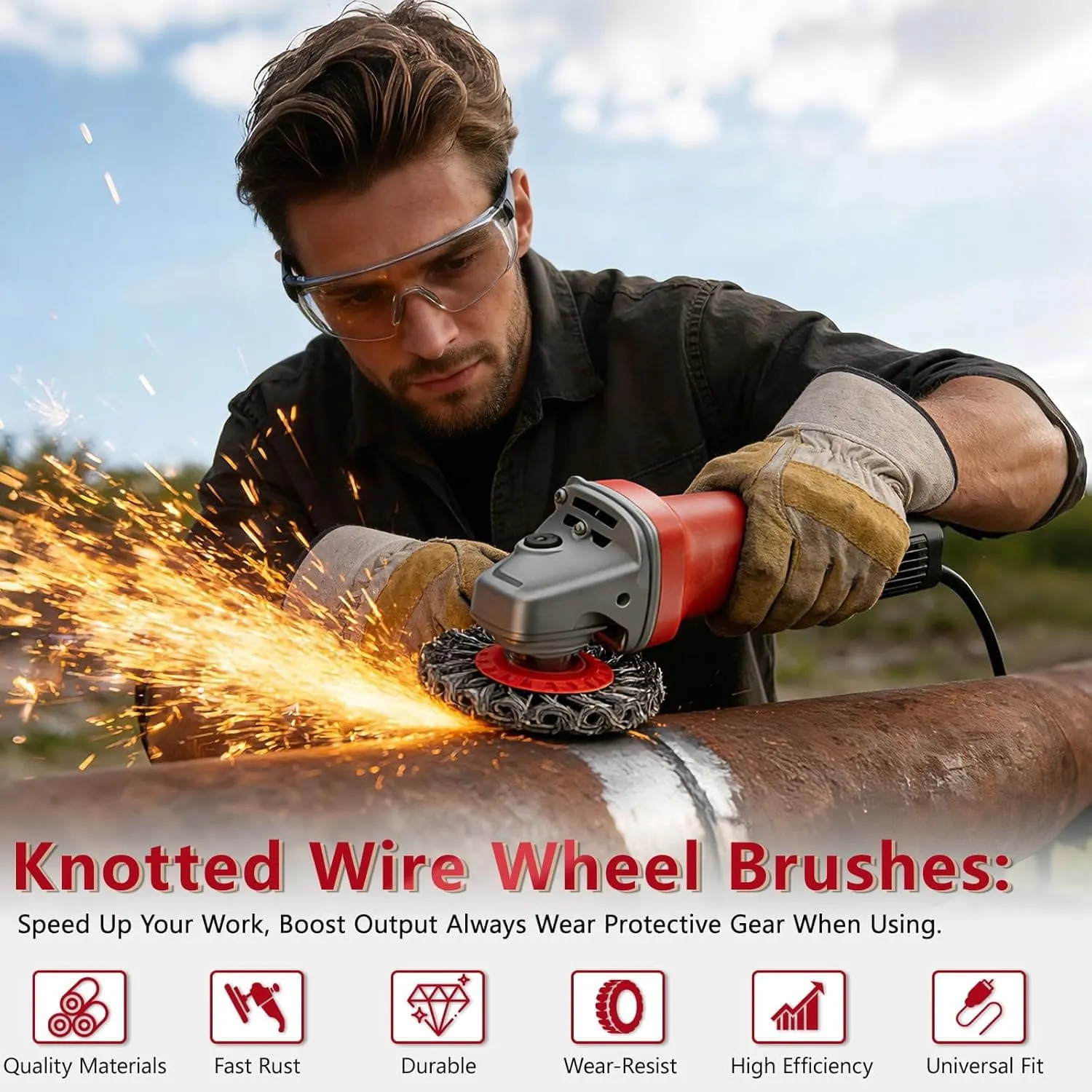
A Wire Wheel Brush is a rotary industrial consumable composed of a central hub and radially arranged high-strength metal wires. It is typically mounted on tools such as angle grinders, power drills, bench grinders, and pedestal grinders. Through high-speed rotation, the centrifugal force and repeated impact and friction of the metal wires enable efficient surface treatment of workpieces.
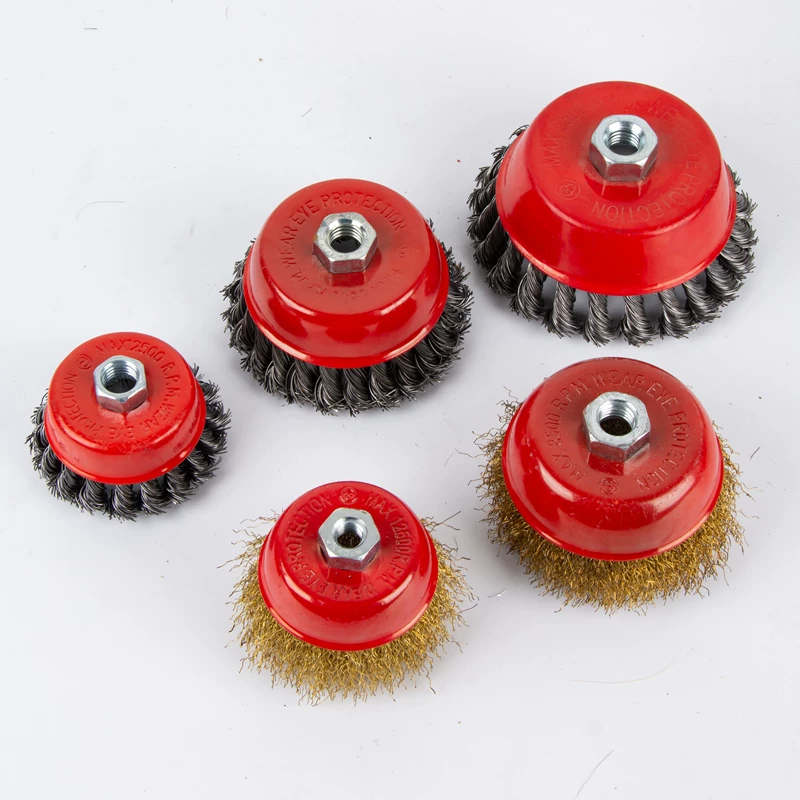
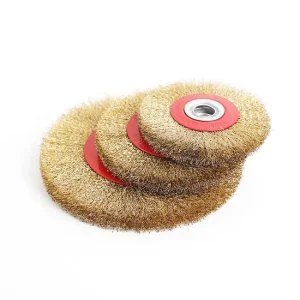
The wire materials can be carbon steel, stainless steel, copper-coated steel, or pure copper wire, and are available in different constructions such as straight wire, crimped wire, and knotted wire, to meet various applications ranging from light cleaning to heavy-duty surface preparation. Wire wheel brushes are widely used for rust removal, oxide layer cleaning, weld spatter removal, deburring, old paint stripping, and surface roughening on metal surfaces.
Non-Metal Application Expansion:
In addition to metals, they are also used on non-metal materials. For example, on wood surfaces, they can clean grain textures, remove surface fibers, and smooth minor imperfections, providing a better base for painting or coating. On stone surfaces, they can be used for cleaning, stain removal, light grinding, and edge finishing, improving both surface texture and visual appearance.
Nylon Abrasive Wheel Brushes (Alternative Option)
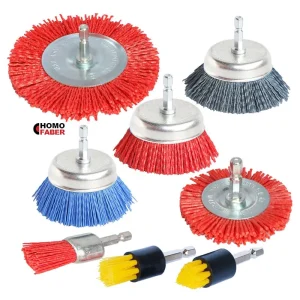
This product category also includes nylon abrasive wheel brushes (Nylon Wheel Brush / Abrasive Filament Wheel Brush), which are made of nylon filaments combined with abrasives such as silicon carbide or aluminum oxide.
Compared with metal wire wheel brushes, nylon brushes provide a much gentler cleaning effect and are less likely to damage the substrate. They also offer non-sparking operation, suitability for both wet and dry environments, and more uniform surface treatment. They are commonly used for fine cleaning, surface finishing, and decorative processing. Nylon wire brush wheels are particularly suitable for wood, composite materials, and workpieces requiring fine surface treatment, achieving both cleaning and light polishing effects.

2. Wire Wheel Brush Full Dimension Matrix Overview
Swipe right for details
| Dimension | Category / Item | Core Features & Technical Description | Typical Applications & Value |
|---|---|---|---|
| Basic Definition & Tools | Rotary Industrial Consumable | Composed of a central hub and radially arranged high-strength metal wires. Uses high-speed rotation and centrifugal force for efficient surface treatment. | Efficient removal of surface layers, contaminants, and conditioning surfaces. |
| Compatible Equipment | Compatible with angle grinders, power drills, bench grinders, and pedestal grinders. | Widely used in machinery manufacturing, automotive repair, and construction industries. | |
| Core Materials | Carbon Steel Wire | Standard industrial option with strong cutting ability and high cost-performance. | General rust removal, oxide cleaning, and old paint stripping. |
| Stainless Steel Wire | Corrosion-resistant, does not leave rust marks on the workpiece. Requiring high cleanliness. | Suitable for stainless steel products and food-grade equipment. | |
| Copper-Coated Wire | Performance between carbon steel and pure copper, with more stable service life. | Medium-intensity surface grinding and general cleaning. | |
| Brass Wire | Soft material, high efficiency and long service life, about 3x the cost of copper-coated wire. | Fine finishing applications, removing dirt without damaging the substrate. | |
| Nylon Abrasive Filament | Nylon fibers combined with silicon carbide or aluminum oxide; non-sparking, suitable for wet/dry. | Wood texturing, composite polishing, and precision surface finishing. | |
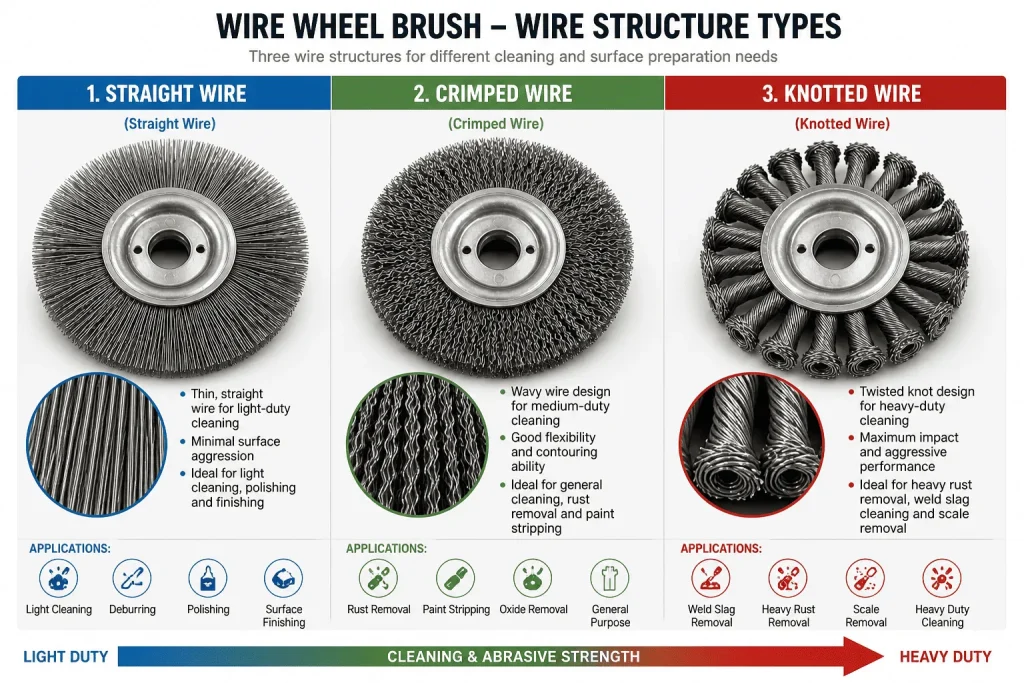
| Structural Types | Straight Wire | Even stress distribution, minimal surface aggression. | Light rust removal, thread cleaning, and light-duty polishing. |
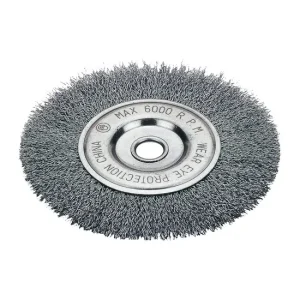
| Crimped Wire | Flexible and elastic; the most common structure on the market. | General-purpose applications, suitable for irregular surfaces. | |
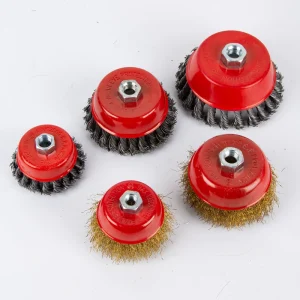
| Knotted Wire | Wires twisted into strands, extremely high impact force for heavy-duty work. | Heavy-duty cleaning: thick rust, weld spatter, and structural steel maintenance. | |
| Application Areas | Metal Processing | Rust removal, oxide cleaning, weld spatter removal, and deburring. | Improves surface smoothness and prepares for coating adhesion. |
| Non-Metal Processing | Wood grain finishing, stone cleaning, surface smoothing, and edge refining. | Enhances surface appearance and improves overall texture and finish quality. |

3. Wire Wheel Brush: Structure and Working Principle
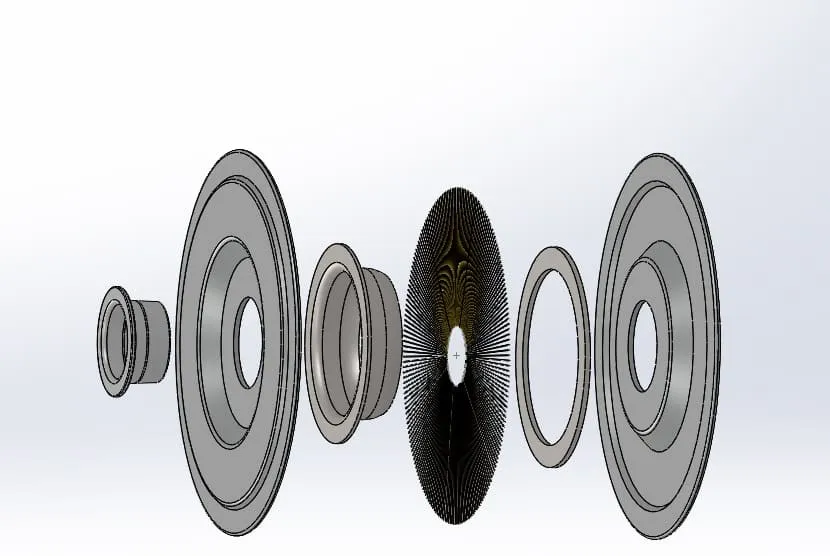
“One Plate, One Ring, Double Flange” Structure
Our flat-hole wire wheel brush adopts multi-layer reinforcement ensuring maximum industrial safety:
- Inner Core Plate: A steel wire positioning plate where wire bundles are first inserted through evenly distributed holes. It controls wire spacing, ensures uniform distribution, maintains dynamic balance, and reduces vibration.
- Arbor Hole Ring: The central mounting core combined with the base flange during initial assembly to form a reinforced center hole, preventing eccentricity or loosening.
- Double Flange System: A safety locking structure. The upper and lower flanges lock the entire structure like a “sandwich” to tightly compress the wire-filled core plate, preventing wire shedding during high-speed grinding.
Working Principle
It works by using high-speed rotating steel wires to repeatedly “strike + brush” the surface to remove contaminants.
When mounted on tools running at high speed, the wires are flung outward and act like many small, stiff brushes. They do not stay in constant contact; instead, they rapidly and repeatedly impact the workpiece while also creating friction.
Efficiently Removes:
Old Paint
Weld Spatter
Oxide Layers
Burrs
Summary: Repeated brushing combined with a light “hammering” effect dramatically improves cleaning efficiency.
4. Wire Wheel Brush: Materials & Wire Structures Deep Dive
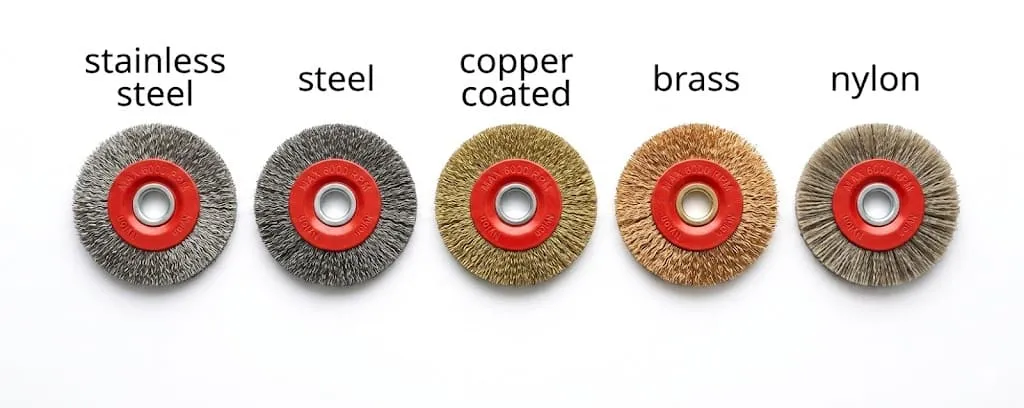
Application Scenarios by Material
Carbon Steel Wire
Features: Strong cutting force. Standard industrial choice.
Applications: General rust/oxide removal, welding slag/spatter cleanup, old paint stripping, general steel structures.
Stainless Steel Wire
Features: Corrosion-resistant, avoids cross-iron contamination.
Applications: Stainless steel products, food processing/medical equipment, chemical environments requiring high cleanliness.
Copper Coated Wire
Features: Better rust resistance than carbon steel, stable service life.
Applications: Medium-duty cleaning, anti-rust prep, surface cleaning before/after welding, general metal grinding.
Brass Wire Wheel
Features: Higher-end, soft, less likely to scratch base metals (3x carbon steel cost).
Applications: Delicate cleaning of aluminum/copper, electrical component maintenance, high precision operations.
Nylon Wire Wheel
Features: Non-damaging, spark-free, perfect for fine finishing.
Applications: Wood grain texturing, composite materials surface treatment, deburring, polishing and decorative processing.
Application Scenarios by Wire Structure
⚠️ Straight Wire Wheel (Light-Duty)
Features: Gentle contact, even stress distribution, minimal surface aggression.
Best For: Light rust removal, thread and small parts cleaning, surface polishing and fine finishing.
⚙️ Crimped Wire Wheel (General-Purpose)
Features: Good flexibility and elasticity. Most commonly used structure on the market.
Best For: Standard rust/oxide removal, surface grinding, deburring, light wood/stone treatment, irregular shapes.
⚡ Knotted Wire Wheel (Heavy-Duty)
Features: Wires twisted into tight strands, extremely high impact force for high-load environments.
Best For: Thick rust layer removal, stubborn welding slag/seam cleanup, heavy steel structure refurbishment, pipeline engineering.
Industry Application Summary Matrix:
• Metal Processing & Welding: Rust removal, welding slag cleaning, deburring, pipeline maintenance.
• Construction & Automotive: Steel structure refurbishment, surface coating prep, automotive parts restoration.
• Woodworking & Decorative: Furniture grain texturing, sanding, stone cleaning and edge finishing.

5. Wire Wheel Brush Installation Methods & Safety Operating Framework
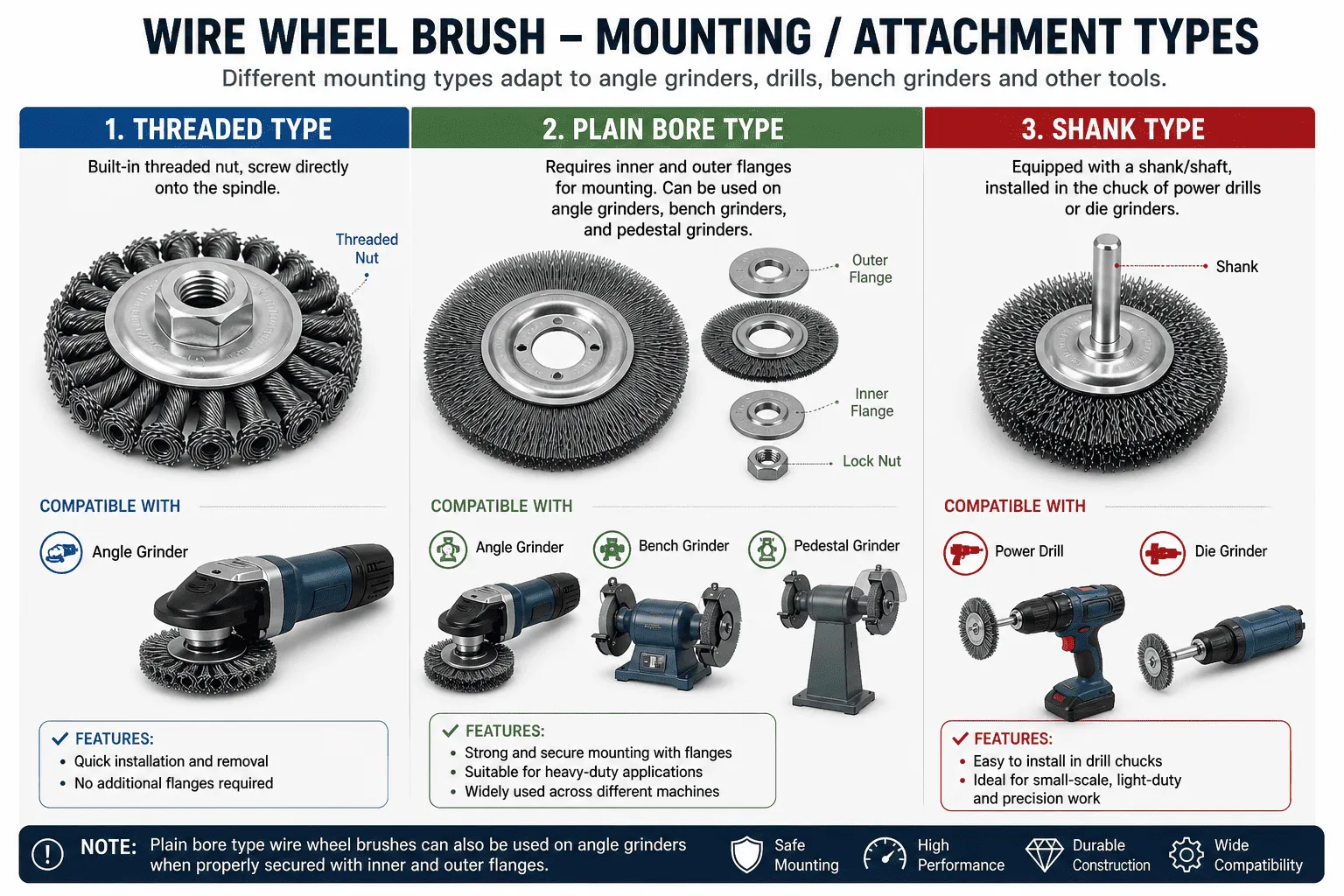
Installation Methods by Mounting / Arbor Types
Option A: Threaded Wire Wheel (e.g. for Angle Grinders)
Manufactured with an internal threaded hole for quick tool changes without extra hardware.
Execution: Align directly with the angle grinder spindle → Screw on like a tight screw → Secure moderately by hand or wrench. (No inner/outer flanges needed).
Option B: Plain Bore Wire Wheel (High Stability Industrial Setup)
For Angle Grinder Mounting Layout:
Inner Flange (spindle support base) → Mount Wire Wheel (align center hole) → Outer Flange (place over outside) → Tighten securely with clamping wrench.
For Bench Grinder / Pedestal Grinder (Using Reducer Rings):
Check bore size. If mismatched, use Reducer Rings (bushing adapters) in pairs on both sides → Install first flanged washer on spindle → Mount wire wheel → Install second flanged washer on opposite side → Lock nut securely via wrench → Reattach safety guard. *Note: Dedicated bench wheels matching spindle diameter do not require reducer rings.
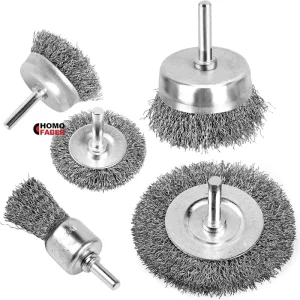
Option C: Shank Type Wire Wheel (Precision / Flexible Drill Work)
Equipped with an integrated shank shaft, perfect for electric drills or small die tools.
Execution: Insert the shank fully into the drill chuck → Tighten the chuck completely until secure. Ideal for small-scale or precision internal spaces.


Operational Execution Methods
Pre-Operation Audit: After installation, run idle for about 10 seconds to ensure there is zero abnormal vibration, wobbling, or noise before contacting the workpiece.
🛡️ Rigorous Safety & PPE Requirements
Personal Protective Equipment (PPE):
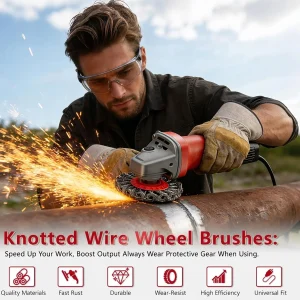
• Safety Goggles / Face Shield: Mandated to block flying broken wire debris.
• Cut-Resistant Gloves & Long Sleeves: Protect skin from aggressive wire brush punctures.
• Dust Mask: Reduce inhalation of removed coatings and oxide fine dust particles.
Tool Specific Safety Mandates:
• Angle Grinder: Protective guard must be installed at all times. Modification is strictly prohibited. Hold with both hands to avoid kickback. Ensure parts are tightened.
• Power Drill: Fully insert shank into the chuck. Avoid excessive lateral forces to prevent shaft bending or wobbling.
• Bench / Pedestal Grinder: Ensure concentric clamping. Protective guard and spark deflector must be fully adjusted. Stand to the side during startup. Match grinder RPM to rated brush specs.
• Post-Use Inspection: Stop tool immediately if weird noise/vibration occurs. Inspect for wear regularly. Clean metal debris out of wires and replace promptly if severe wear or broken wires are found. Do not use in flammable/explosive environments.


6. Engineering Perspective: How to Identify a High-Quality Wire Wheel Brush
From an abrasive engineering perspective, structural strength alone is insufficient. High-performance brushes must satisfy four core metallurgical and mechanical testing criteria simultaneously to survive high-speed, heavy-duty industrial tasks:
High-quality carbon steel wire must achieve a tensile strength of 2200 MPa or higher for optimal elasticity recovery. Stainless wire (302/304) must prevent iron cross-contamination. Copper-coated wires require uniform coating thickness for a mild self-lubricating thermal effect. Overall wire diameter and hardness must be perfectly uniform across batches to prevent premature fatigue failure.
Requires an even crimping pattern on crimped models and tight, stable knot structures without outward-flaring wires on knotted models. This ensures stable cutting force and uniform breakdown during contact operations.
At high rotational speeds (8,000–12,000 RPM), wire wheel brushes are subjected to significant centrifugal forces, where even minor mass imbalance can result in amplified vibration and operational instability.
To ensure stable and safe performance, high-quality products are manufactured and verified under dynamic balancing principles aligned with ISO 1940-1 / ISO 21940 standards for rotating machinery balance quality.
This process controls residual unbalance within acceptable balance grades, reducing vibration levels during operation and helping to protect grinder spindles and bearings from premature wear or mechanical failure.
Employs high-strength alloy stamped hubs with precision threads showing high coaxiality. Real-world performance yields controlled wear (even wire loss rather than sudden chunks breaking off) and stable cutting speeds over time without structural shape distortion.
• Visual Inspection: Ensure uniform radial wire distribution with no missing sections or flare defects.
• Sound & Tactile Check: Smooth, stable sound during idle spin-up with zero hand-numbing vibration.
• Compliance Markings: Reputable products must explicitly list Maximum Safe RPM and safety standard certifications like ANSI / EN.

7. Wire Wheel Brush Systematic Selection Protocol
Do not rely on a single parameter. Engineers always match configurations across four core vectors:
• Carbon Steel: Maximum force, cost-effective, but prone to oxidation and rusts stainless steel.
• Stainless Steel: Corrosion environments, zero cross-contamination, higher cost.
• Copper Coated: Mild friction heat, moderate rust resistance.
• Brass/Nylon: Soft metal safety, fine wood grain finishing, zero metal cutting force.
• Straight Wire: Light surface polishing, low-wear precision work.
• Crimped Wire: Balanced elasticity/durability, standard paint removal, widest general purpose usage.
• Knotted Wire: Severe impact cutting, stripping of thick rust layers, high-aggression slag removal.
• Threaded (M14 etc.): Direct angle grinder mounting, rapid tool swapping, no loose components.
• Plain Bore: High structural stability layout on heavy bench/pedestal setups.
• Shank Type: Drills and handheld flexible shaft tools for intricate components.
Engineered Cheat Sheet Rule:
• Large-scale heavy rust stripping: Knotted wire + Carbon steel + Threaded high-power Angle Grinder.
• General-purpose cleaning jobs: Crimped wire + Carbon steel or Stainless steel wire core.
• Fine delicate surface processing: Straight wire + Brass/Nylon wire + Shank type mounting.
• Stainless steel welding parts: Strictly mandatory to use Stainless Steel wire (Never mix to avoid galvanic corrosion rust).

8. Project Case Study: Shipyard Large Oil Tank Weld Seam Cleaning Using Wire Wheel Brushes
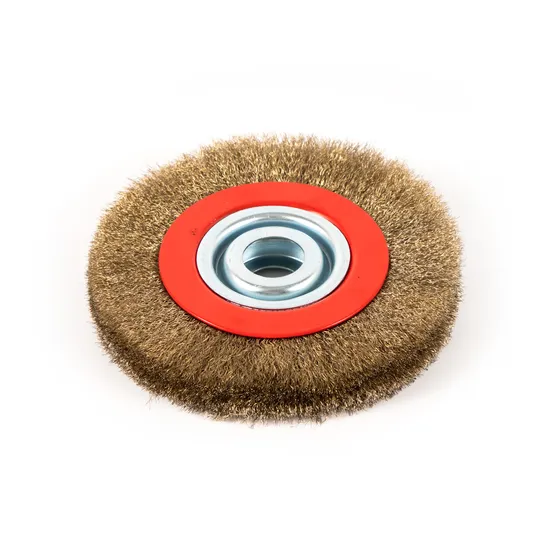
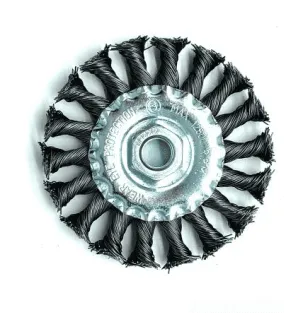

Wheel brushes, crimped wire(Threaded )
industrial quality, for use on angle grinders
advantages:
effective for woodworking
applications:
for demanding light-duty work, deburring, paint removal, cleaning threads and more
Swipe right for details
| ø (mm) | g | max. rpm | t (mm) |
| 75 | 14×2 | 4500 | 16.8 |
| 75 | 5/8″-11 | 4500 | 16.8 |
| 100 | 14×2 | 4500 | 22 |
| 100 | 5/8″-11 | 4500 | 22 |
| 115 | 14×2 | 4500 | 28 |
| 115 | 5/8″-11 | 4500 | 28 |
| 125 | 14×2 | 4500 | 29 |
| 125 | 5/8″-11 | 4500 | 29 |
| 150 | 14×2 | 4500 | 33 |
| 150 | 5/8″-11 | 4500 | 33 |
| 175 | 14×2 | 4500 | 33 |
| 175 | 5/8″-11 | 4500 | 33 |
| 200 | 14×2 | 3750 | 42 |
| 200 | 5/8″-11 | 3750 | 42 |

Wheel brushes, abrasive filament(Threaded )
advantages:
can be used in wet and dry
additional strength compared to straight brushes
providing longer life and more consistent finish
applications:
use for cleaning, polishing, surface refining, decorative finishes, light burr and stain removal, finishing of wood products
wire option:
0.8mm/1.3mm (red)
0.8mm/1.3mm (grey)
0.8mm/1.3mm (blue)
Swipe right for details
| item no. | ø (mm) | g | max. rpm | t (mm) |
| hy8832n | 75 | 14×2 | 4500 | 16 |
| hy8832n | 75 | 5/8″-11 | 4500 | 16 |
| hy8832n | 100 | 14×2 | 4500 | 22 |
| hy8832n | 100 | 5/8″-11 | 4500 | 22 |
| hy8832n | 115 | 14×2 | 4500 | 28 |
| hy8832n | 115 | 5/8″-11 | 4500 | 28 |
| hy8832n | 125 | 14×2 | 4500 | 29 |
| hy8832n | 125 | 5/8″-11 | 4500 | 29 |
| hy8832n | 150 | 14×2 | 4500 | 33 |
| hy8832n | 150 | 5/8″-11 | 4500 | 33 |

wheel brushes, knotted wire(Plain Bore)
industrial quality, for use on all common angle grinders
advantages:
low flex high impact aggressive brush action
for heavy-duty cleaning applications
applications:
general cleaning, weld cleaning, removal of rubber flash, scale, rust, and pipeline cleaning, deburring
Swipe right for details
| ø (mm) | b | max. rpm | t (mm) | knot |
| 100 | 16/22.2 | 12500 | 20 | 18/22 |
| 115 | 16/22.2 | 12500 | 22 | 18/20/22 |
| 125 | 16/22.2 | 10000 | 24 | 18 |
| 150 | 16/22.2 | 9000 | 26 | 30 |
| 175 | 16/22.2 | 9000 | 38.5 | 30 |
| 200 | 16/22.2/25.4 | 9000 | 41 | 35 |
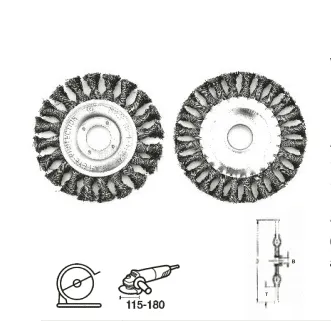
Stringer Wheel brushes, knotted wire(Plain Bore)
industrial quality, for use on all common angle grinders
advantages:
for heavy-duty cleaning applications
also for use with a bench, pedestal or straight grinder
applications:
suitable for cleaning root and hot passes, pipe welds, groove and weld bead, corners, rough surface preparation
Swipe right for details
| ø (mm) | b | max. rpm | t (mm) | knot |
| 100 | 16/22.2 | 12500 | 20 | 30 |
| 115 | 16/22.2 | 10000 | 24 | 32 |
| 125 | 16/22.2 | 10000 | 23 | 40 |
| 150 | 16/22.2 | 9000 | 26 | 52 |
| 175 | 16/22.2 | 9000 | 38.5 | 52 |
| 200 | 16/22.2/25.4 | 9000 | 41 | 56 |

industrial quality, use on bench and pedestal grinders
advantages:
narrow-faced brushes are ideal for general-purpose brushing of uneven or difficult-to-reach surfaces
applications:
work on a workbench grinder or table deburrer for rust/paint removal, cleaning, roughening or deburring, sawn cutting edges and surfaces
Swipe right for details
| ø (mm) | d | max. rpm | t (mm) | adaptor |
| 75 | 13 | 4500 | 16 | 1/2″ 5/8″ |
| 100 | 13/16/22.2 | 4500 | 22 | 1/2″ 5/8″ 3/4″ 7/8″ |
| 115 | 13/16/22.2 | 4500 | 23 | 1/2″ 5/8″ 3/4″ 7/8″ |
| 125 | 13/16/22.2 | 4500 | 29 | 1/2″ 5/8″ 3/4″ 7/8″ |
| 150 | 13/16/22.2 | 4500 | 33 | 1/2″ 5/8″ 3/4″ 7/8″ |
| 175 | 13/16/22.2 | 4500 | 33 | 1/2″ 5/8″ 3/4″ 7/10″ |
| 200 | 13/16/22.2 | 3750 | 41 | 1/2″ 5/8″ 3/4″ 7/12″ |
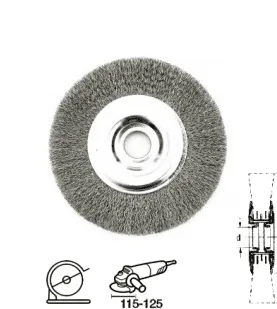
industrial quality, for use on angle grinders
advantages:
can be used in wet and dry
additional strength compared to straight brushes
providing longer life and more consistent finish
applications:
use for cleaning, polishing, surface refining, decorative finishes, light burr and stain removal, finishing of wood products
wire option:
0.8mm/1.3mm (red)
0.8mm/1.3mm (grey)
0.8mm/1.3mm (blue)
Swipe right for details
| ø (mm) | b | max. rpm | t (mm) |
| 75 | 13 | 4500 | 16 |
| 100 | 13/16/22.2 | 4500 | 22 |
| 115 | 13/16/22.2 | 4500 | 23 |
| 125 | 13/16/22.2 | 4500 | 29 |
| 150 | 13/16/22.2 | 4500 | 33 |

Wheel brushes, crimped wire(Plain Bore)
industrial quality, use on bench and pedestal grinders
advantages:
high wire density
wires for high deburring performance
constructed for even balance which provides smooth performance
applications:
work on a workbench grinder or table deburrer for rust/paint removal, cleaning, roughening or deburring
Swipe right for details
| ø (mm) | b | max. rpm | t (mm) | adaptor |
| 100 | 20 | 6000 | 21 | 1/2″ 5/8″ |
| 125 | 20 | 6000 | 30 | 1/2″ 5/8″ 3/4″ 7/8″ |
| 150 | 32 | 6000 | 30 | 1/2″ 5/8″ 3/4″ 7/8″ |
| 175 | 32 | 6000 | 40 | 1/2″ 5/8″ 3/4″ 7/8″ |
| 200 | 32 | 4500 | 43 | 1/2″ 5/8″ 3/4″ 7/8″ |
| 250 | 32 | 4500 | 50 | 1/2″ 5/8″ 3/4″ 7/10″ |
| 300 | 32 | 4500 | 72 | 1/2″ 5/8″ 3/4″ 7/12″ |

Wheel brushes, crimped wire(Plain Bore)
industrial quality, use on bench and pedestal grinders
advantages:
high wire density
aggressive variant
constructed for even balance which provides smooth performance
applications:
work on a workbench grinder or table deburrer for rust/paint removal, cleaning, roughening or deburring
Swipe right for details
| ø (mm) | d | max. rpm | t (mm) | w | adaptor |
| 150 | 16 | 6000 | 30 | 25 | 1/2″ 5/8″ 3/4″ 7/8″ |
| 150 | 25 | 6000 | 30 | 25 | 1/2″ 5/8″ 3/4″ 7/8″ |
| 200 | 16 | 4500 | 43 | 25 | 1/2″ 5/8″ 3/4″ 7/8″ |
| 200 | 25 | 4500 | 43 | 25 | 1/2″ 5/8″ 3/4″ 7/8″ |

Wheel brushes, abrasive filament(Plain Bore)
industrial quality, for bench and pedestal grinders, and deburring machines
advantages:
used in wet and dry environments
high performance, safety
a longer and more consistent useable life when compared to metal wire
applications:
deburring of pipes, flat parts, cleaning wood surfaces
wire option:
0.8mm/1.3mm (red)
0.8mm/1.3mm (grey)
0.8mm/1.3mm (blue)
Swipe right for details
| ø (mm) | d | max. rpm | t (mm) | adaptor |
| 75 | 16 | 6000 | 16 | 1/2″ |
| 100 | 20 | 6000 | 21 | 1/2″ 5/8″ |
| 125 | 20 | 6000 | 30 | 1/2″ 5/8″ |
| 150 | 32 | 6000 | 30 | 1/2″ 5/8″ |
| 175 | 32 | 6000 | 40 | 1/2″ 5/8″ 3/4″ 7/8″ |
| 200 | 32 | 4500 | 40 | 1/2″ 5/8″ 3/4″ 7/8″ |
| 250 | 32 | 4500 | 50 | 1/2″ 5/8″ 3/4″ 7/8″ |
| 300 | 32 | 4500 | 72.5 | 1/2″ 5/8″ 3/4″ 7/8″ |

Wheel brushes, crimped wire(Shank Type)
industrial quality, for use on power drills and high-speed machines
advantages:
short brush diameter enables access to corners
narrow-faced brushes are ideal for general-purpose brushing of uneven or difficult-to-reach surfaces
applications:
work on a workbench grinder or table deburrer for rust/paint removal, cleaning, roughening or deburring, sawn cutting edges and surfaces
Swipe right for details
| ø (mm) | s | max. rpm | L (mm) |
| 25 | 6/6.3 | 4500 | 4 |
| 37 | 6/6.3 | 4500 | 6.8 |
| 50 | 6/6.3 | 4500 | 11 |
| 62 | 6/6.3 | 4500 | 17 |
| 75 | 6/6.3 | 4500 | 17 |
| 100 | 6/6.3 | 4500 | 22.5 |
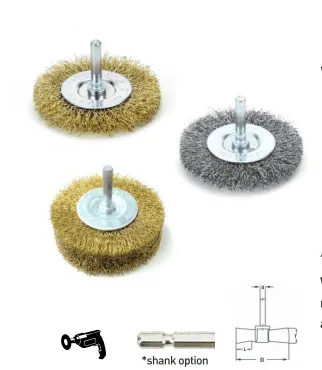
Wheel brushes, abrasive filament(Shank Type)
craftsman quality, for power drills
advantages:
non-sparking
can be used wet or dry
non-shedding filament
flexes around uneven surfaces such as nuts & bolts
applications:
suitable for all materials; for the easy roughing and smoothing of surfaces for woodworking
wire option:
0.8mm/1.3mm (red)
0.8mm/1.3mm (grey)
0.8mm/1.3mm (blue)
Swipe right for details
| ø (mm) | s | max. rpm | L (mm) |
| 50 | 6/6.3 | 4500 | 11 |
| 75 | 6/6.3 | 4500 | 17 |
| 100 | 6/6.3 | 4500 | 23 |

Wheel brushes, knotted wire(Shank Type)
industrial quality, for use on power drills and high-speed machines
advantages:
high cleaning performance
longer life and aggressive rough finishing
provides the most aggressive brushing action
applications:
used in general purpose deburring and cleaning, removal of rust, scale paint and weld splatte
Swipe right for details
| ø (mm) | s | max. rpm | l (mm) | knot |
| 75 | 6/6.3 | 12500 | 15.5 | 14 |
| 100 | 6/6.3 | 11000 | 20.5 | 18 |

10. Technical FAQ & Troubleshooting
Looking for a Reliable Wire Wheel Brush Supplier?
We are a direct source factory and comprehensive abrasive tools manufacturer from China, specializing in the R&D, production, and global export of elite metal surface treatment tools. We provide professional industrial-grade solutions tailored precisely to your production floor constraints.
Our portfolio fully encompasses Carbon Steel, Stainless Steel, Copper Coated, Brass, and Nylon wire variants across Straight, Crimped, and Knotted matrix configurations.Our products are compatible with angle grinders, bench grinders, and power drills. Available in threaded, arbor hole, and shank-mounted options for fast installation and maximum versatility.
11. Reference
- International Organization for Standardization. ISO 1940-1:2003. Mechanical vibration — Balance quality requirements of rigid rotors — Part 1: Specification and verification of balance tolerances.
- International Organization for Standardization. ISO 21940-11:2016. Mechanical vibration — Rotor balancing — Part 11: Procedures and tolerances for rotors with rigid behaviour.




 English