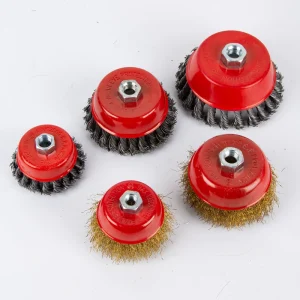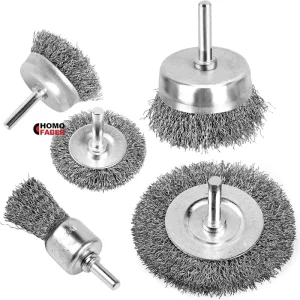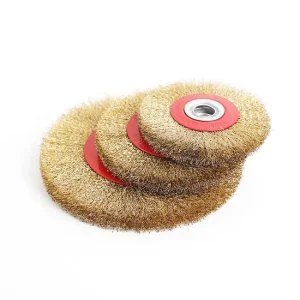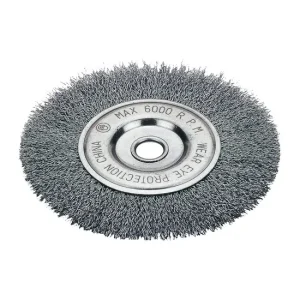
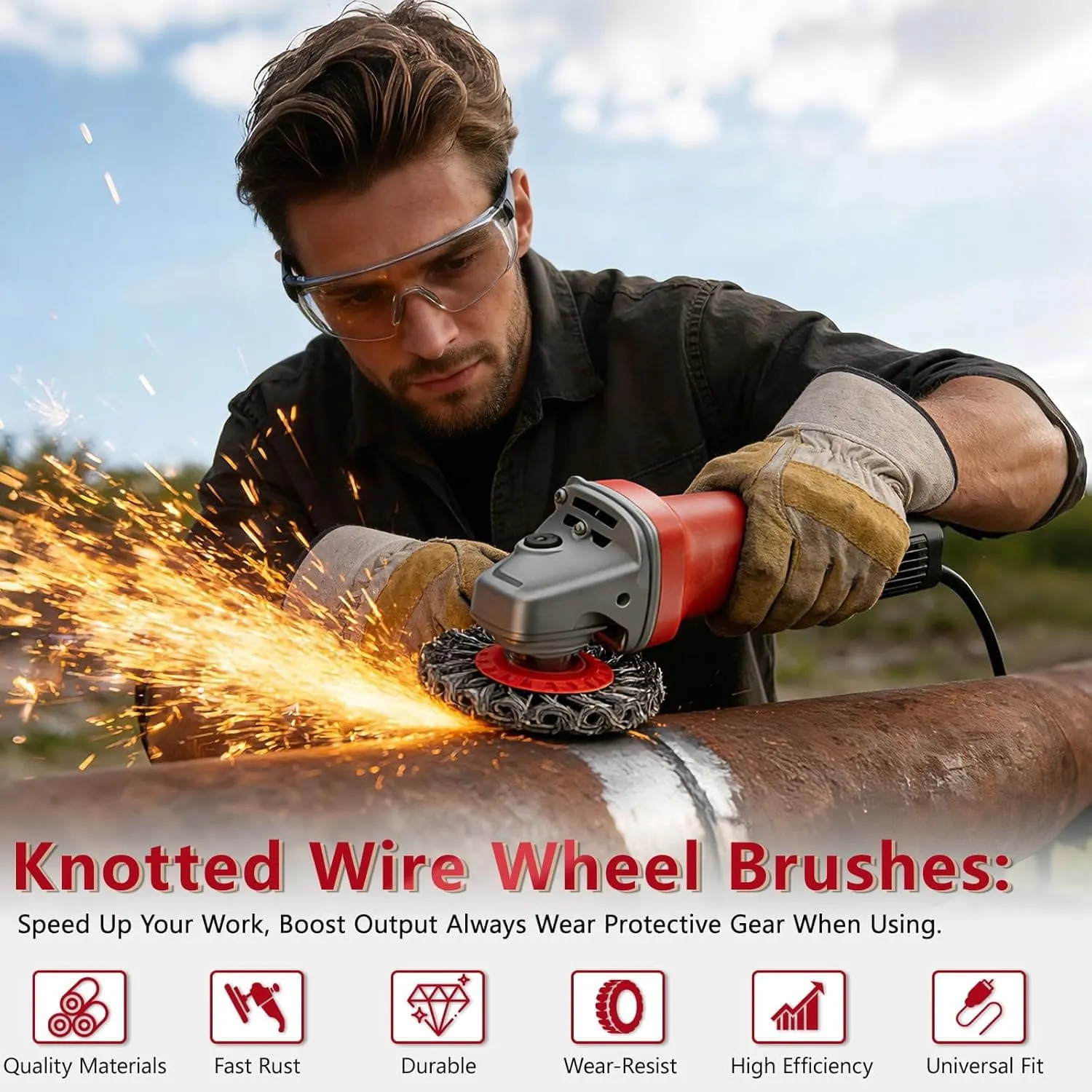
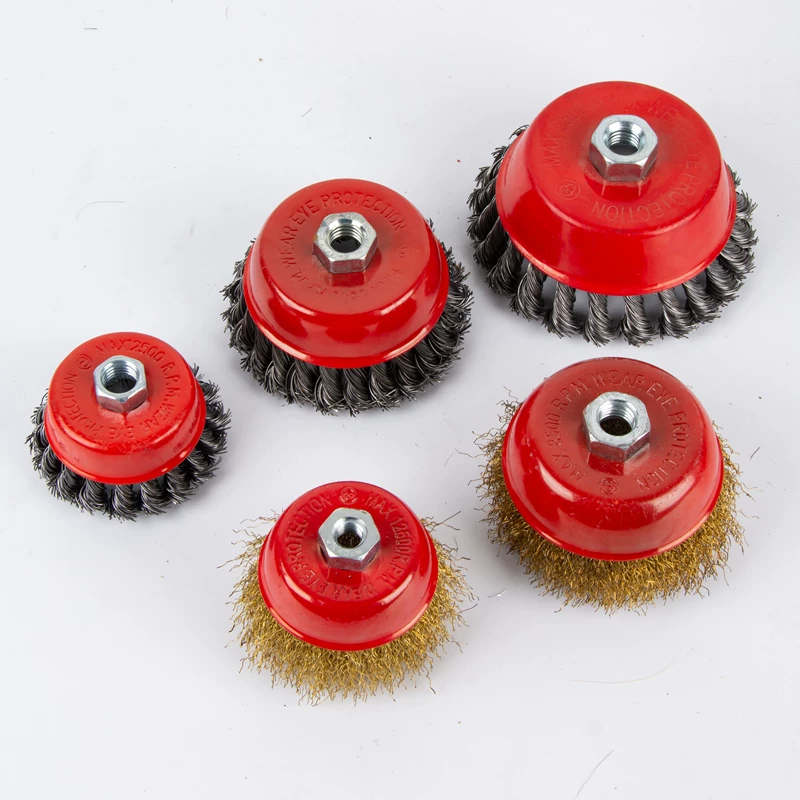



If your working environment is humid, contains corrosive media, or requires rust prevention on the workpiece surface, choose stainless steel wire brushes. If you prioritize high removal efficiency, are cost-sensitive, and the workpiece itself is not affected by trace carbon residue, carbon steel wire brushes are the more economical choice. In reality, however, the decision is far more nuanced than this binary judgment. Below, we break down the issue across four dimensions — material, application scenario, cost, and maintenance — to give you a complete picture.
Core Differences at a Glance
If you are pressed for time, the table below summarizes the essential differences between the two types of brushes:
| Dimension | Stainless Steel Wire Brush | Carbon Steel Wire Brush |
|---|---|---|
| Material | 304 / 316 and other stainless steel wires | High-carbon steel wire (typically 0.6%–1.0% carbon content) |
| Hardness | Medium to moderately soft | High hardness, greater rigidity |
| Rust Resistance | Excellent — suitable for long-term use in humid environments | Poor — rusts on contact with water; bristles break off one by one |
| Removal Efficiency | Moderate | High — strong cutting force |
| Effect on Workpiece | Light surface scratches; does not leave rust spots | May leave carbon steel particles, causing subsequent rusting on workpiece surface |
| Price | Approximately 2–4 times that of carbon steel | Economical and affordable |
| Typical Service Life (Dry Environment) | Long | Long (but rapidly scrapped once rust sets in) |
| Upper Temperature Limit | Stable up to 870 °C (Type 304) | Approximately 200–250 °C (hardness drops noticeably at elevated temperatures) |
| Food / Pharmaceutical Compliance | Yes (Type 316) | No |
This table is a “snapshot” to help you quickly narrow down your options in urgent procurement situations. However, if you are making a bulk purchasing decision, the detailed analysis that follows is well worth reading section by section.
Introduction
When it comes to choosing wire brushes, many factories have gone over a decade without any issues — until one day, out of the blue, a customer files a complaint: rust spots have appeared next to the weld seams on the product. After investigating every possible cause, the culprit turns out to be something unexpected — an ordinary carbon steel wire brush.
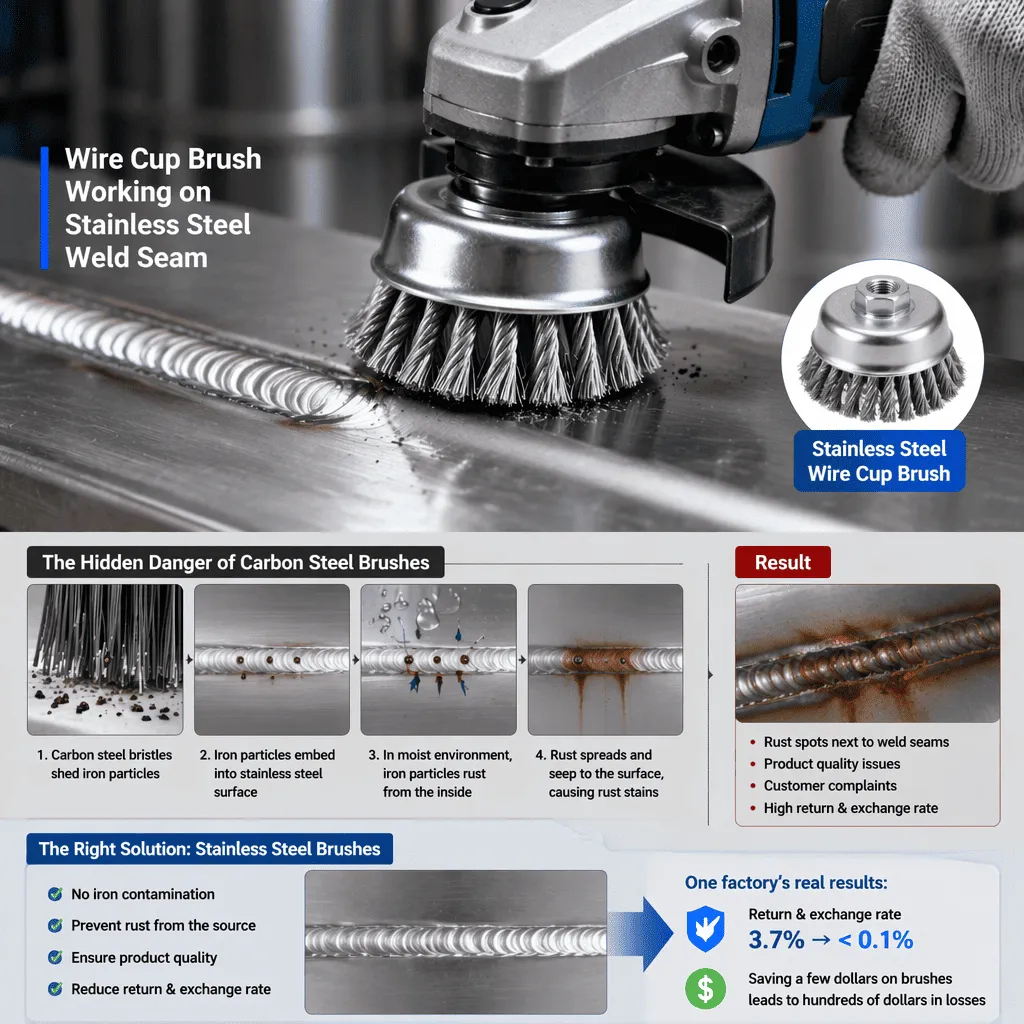
We once worked with a factory specializing in stainless steel pressure vessels. Their welders had been using carbon steel wire brushes to treat weld seams for years — because they were efficient, comfortable to use, and cost only a few dollars each. Nobody thought there was a problem for several years, until they started receiving customer complaints quarter after quarter. A dedicated failure analysis revealed that iron particles shed by the carbon steel bristles during friction had embedded themselves into the stainless steel surface. Upon contact with moisture in the air, corrosion began spreading from the inside out, seeping rust stains to the surface. After switching to stainless steel brushes, the brush procurement cost nearly tripled — but the return and exchange rate dropped from 3.7% to below 0.1%. Saving three or four dollars on a brush only to incur a return loss of several hundred dollars — that math simply does not work out.
Choosing a brush is not about choosing a consumable — it is about choosing process assurance. The sole purpose of this article is to help you get this decision right.
What Is a Stainless Steel Wire Brush?
A stainless steel wire brush uses stainless steel alloy wire as its bristle material. The two most common grades on the market are Type 304 stainless steel, suitable for general industrial applications, and Type 316 stainless steel, suitable for high-demand environments such as food contact, pharmaceuticals, or marine corrosion.
The fundamental reason stainless steel is “stainless” lies in its chromium content. According to the EN 10088 standard, the chromium content in stainless steel must reach 10.5% or higher. The chromium element reacts with oxygen on the material surface to form a dense and stable chromium oxide (Cr₂O₃) passive film.
This passive film significantly reduces the contact between the metal and corrosive media such as moisture and oxygen, thereby slowing the corrosion process. More importantly, when the surface sustains minor mechanical damage, the passive film can regenerate spontaneously in an oxygen-containing environment — a phenomenon known in metallurgy as “self-healing passivation.” This is a property that ordinary carbon steel completely lacks.
Type 304 stainless steel contains approximately 18% chromium and 8% nickel. Type 316 stainless steel additionally incorporates 2%–3% molybdenum, which significantly enhances resistance to chloride ion corrosion. This is why the food industry must use Type 316 rather than Type 304 — food processing involves extensive use of chlorine-based disinfectants. Type 304 is prone to pitting corrosion in environments with high chloride ion concentrations, whereas Type 316 is not.
1.1 Advantages of Stainless Steel Wire Brushes
- Does not rust, does not contaminate the workpiece. This is the attribute most valued by procurement personnel. When cleaning stainless steel, aluminum alloy, copper alloy, and similar workpieces, carbon steel brushes can leave behind microscopic carbon steel or iron particles on the workpiece surface. These particles, upon encountering humid air, turn into rust spots or trigger dissimilar-metal contamination corrosion. Stainless steel brushes transfer no residue whatsoever during weld seam and surface cleaning, achieving true “steel-to-steel” treatment. In many high-specification applications, this is not a bonus feature — it is a non-negotiable requirement.
- Corrosion-resistant environment. Type 304 stainless steel remains stable in most acidic and alkaline environments, and Type 316 stainless steel can even withstand marine-grade salt spray corrosion. Whether in high-humidity workshop conditions or extreme environments involving chemical cleaning solutions in the process flow, stainless steel brushes are the only rational choice, offering exceptionally strong resistance to harsh conditions.
- Long service life, lower actual cost. In humid or semi-humid conditions, a carbon steel wire brush may begin to rust, shed bristles, or even become unusable within a week, whereas a stainless steel brush can operate reliably for months or even longer. The actual cost per unit of time over the full lifecycle is often no higher than that of carbon steel. Many procurement personnel look only at unit price without calculating service life — a common point of misjudgment.
- Finer surface treatment. Stainless steel wire has a slightly lower hardness than carbon steel, making it safer and more controllable when working on precision workpieces or soft metal surfaces. It achieves the desired cleaning effect while perfectly preserving the surface finish of the workpiece, with less risk of scratching the substrate.
- Compliance with stringent industry regulations.In industries such as food processing and pharmaceuticals, preventing contamination is essential. Regulations like FDA 21 CFR and EU 1935/2004 set strict requirements for materials in contact with food. Stainless steel brushes are the preferred choice for these environments, as they help reduce the risk of iron contamination and support hygienic processing standards.
1.2 Disadvantages of Stainless Steel Wire Brushes
- Higher price. The raw material cost of stainless steel wire is 3–5 times that of carbon steel wire. Coupled with greater processing difficulty, the price of a finished stainless steel brush is typically 2–4 times that of a comparable carbon steel product. For bulk, consumable-type procurement, the difference in initial investment is very noticeable. However, this must be evaluated over the full lifecycle, not by purchase unit price alone.
- Removal efficiency not on par with carbon steel. Stainless steel wire has lower hardness and rigidity than high-carbon steel wire. When heavy oxide scale, paint layers, or welding slag must be aggressively removed, the “cutting power” of stainless steel brushes is noticeably weaker than that of carbon steel. Operators often need longer working hours to accomplish the same rust removal task, which translates into increased labor and time costs.
- Performance limitations at high temperatures. Although the upper temperature limit of stainless steel is higher than that of carbon steel, stainless steel wire will undergo annealing and softening above 400 °C, losing its elasticity. In high-temperature grinding scenarios (such as hot descaling of castings), the advantages of stainless steel brushes are not pronounced.
1.3 Typical Application Scenarios for Stainless Steel Wire Brushes
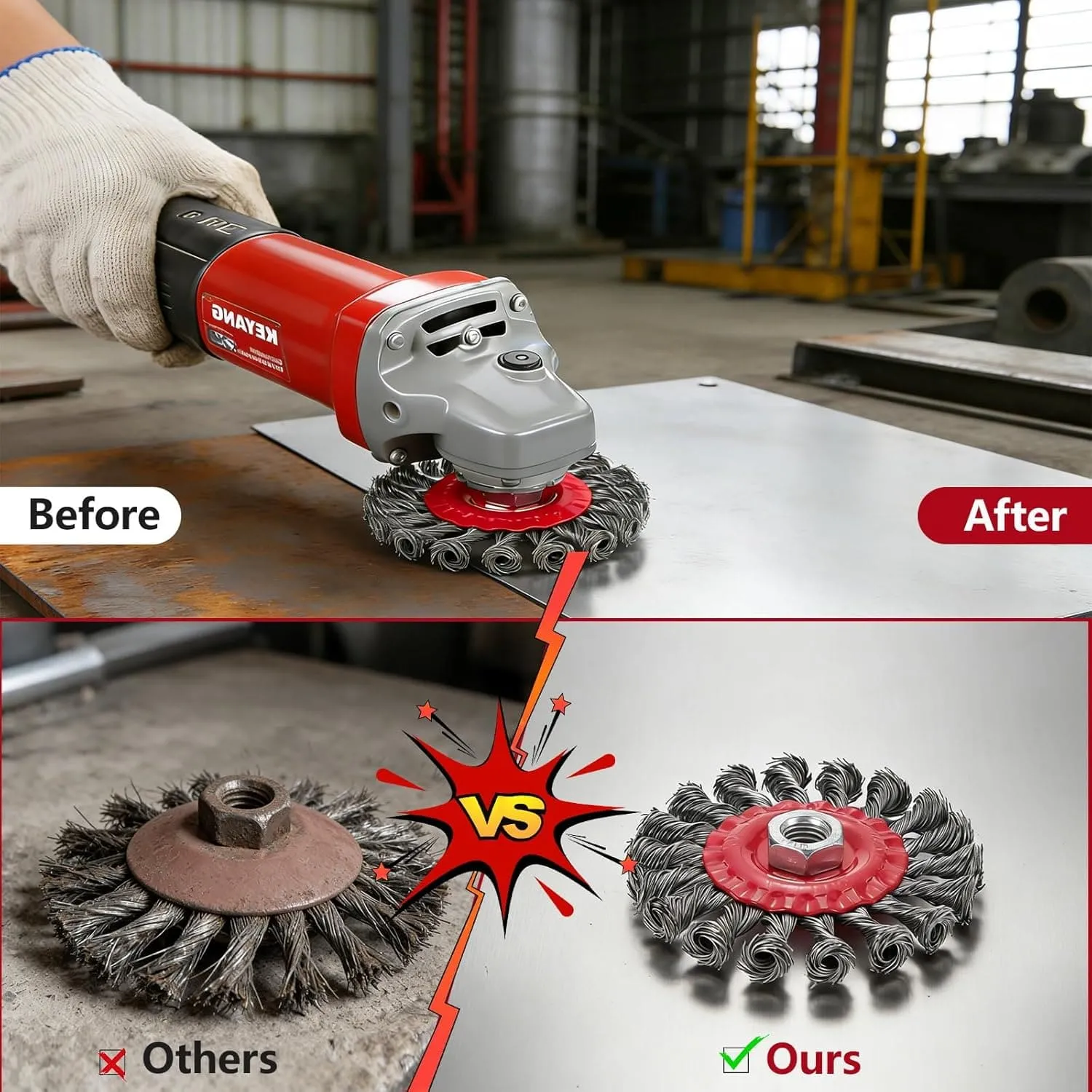
- Surface cleaning and post-weld treatment of stainless steel workpieces (plates, pipes, vessels, weld seams)
- Rust removal and anti-corrosion treatment for ships and offshore engineering platforms (long-term salt spray corrosion environments)
- Maintenance of food processing equipment and pharmaceutical equipment (Type 316 must be used)
- Chemical plant equipment maintenance (environments with acidic or alkaline media)
- Surface treatment of non-ferrous metals such as aluminum alloy and copper alloy (to avoid iron contamination)
- Precision metal surfaces requiring decorative brushing finish, where iron contamination is not permitted
What Is a Carbon Steel Wire Brush?
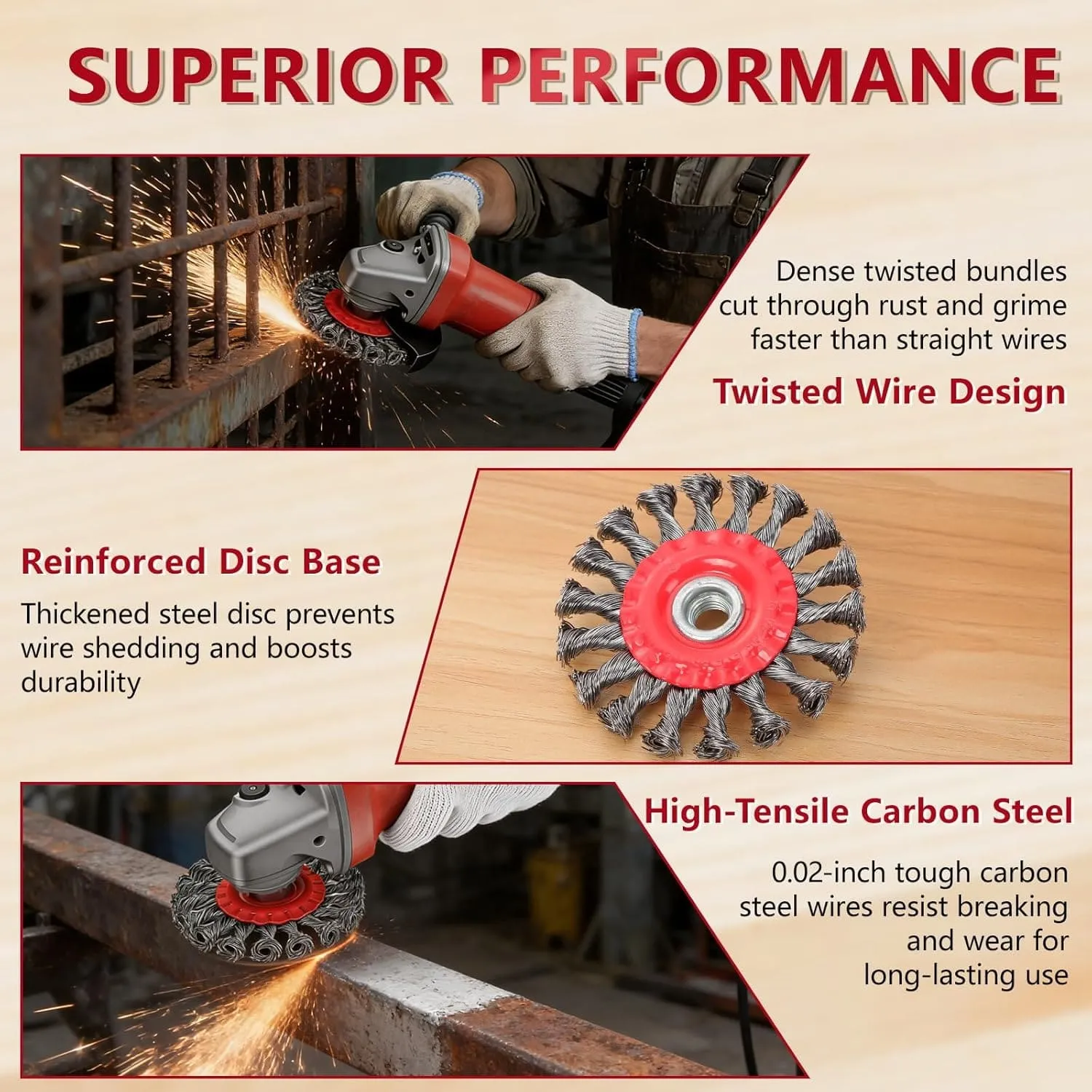
A carbon steel wire brush uses high-carbon steel wire as its bristle material. After drawing and heat treatment, high-carbon steel wire can reach a hardness of HRC 50 or above (HRC: a metric used to measure a metal material’s resistance to indentation by a hard object — the higher the value, the harder the material), delivering exceptional rigidity and cutting ability. In fields such as heavy-duty rust removal, welding slag cleaning, and foundry casting descaling, carbon steel wire brushes remain the primary choice in many factories to this day.
Here is a real-world reality in the industry: many procurement veterans with over a decade of experience still firmly choose carbon steel brushes for bulk rust removal orders in dry environments — not because they do not understand the benefits of stainless steel, but because after running the numbers, they find that carbon steel brushes, in the right operating conditions, offer a cost-performance ratio that is hard to refuse.
2.1 Advantages of Carbon Steel Wire Brushes
- Extremely high removal efficiency. The hardness and rigidity of high-carbon steel wire far exceed those of stainless steel wire. The bristles demonstrate very strong “biting” capability against rust, oxide scale, and paint layers during rotary or reciprocating motion. To remove the same layer of heavy rust, a carbon steel brush may require only half — or even less — of the time needed by a stainless steel brush. On a production line where man-hours directly equate to cost, this efficiency gap translates into real dollar savings.
- Clear price advantage. This is the greatest competitive strength of carbon steel wire brushes. In dry environments where the workpiece has no rust-prevention requirements, the unit price of a carbon steel brush may be only one-third to one-quarter that of a stainless steel brush of the same specification. For large factories consuming hundreds or even thousands of brushes per month, the price difference multiplied by quantity represents substantial cost savings.
- Greater rigidity, suitable for heavy-duty operations. Carbon steel wire does not easily bend or deform under pressure, allowing operators to apply greater force to accelerate the cleaning process. In the rough grinding operations of foundries and shipyards, this rigidity ensures production efficiency, and workers find it more “satisfying” to use — this is genuine feedback from many frontline operators.
- Stable supply, full range of specifications. The manufacturing process for carbon steel wire brushes is mature, and raw material supply is abundant. Virtually every brush type on the market (wheel brushes, end brushes, twisted-knot brushes, cup brushes, etc.) is available in carbon steel versions. Procurement lead times are short, and there is virtually no risk of stockouts.
2.2 Disadvantages of Carbon Steel Wire Brushes
- Prone to rust — an irremediable weakness. Carbon steel wire rusts upon contact with water or humid air, and once rust sets in, bristles break off one by one from the base, drastically shortening service life. If the humidity in your workshop consistently exceeds 60%, the lifespan of carbon steel brushes will be severely compromised. Even more troublesome — rusted bristle fragments that break off can become mixed into the workpiece surface, posing hidden risks to your product quality.
- Contaminates workpiece surfaces. This is a pitfall that many novice procurement personnel have fallen into. When cleaning stainless steel workpieces with a carbon steel brush, carbon steel particles from the bristles embed themselves into the stainless steel surface. Within days, scattered specks of rust appear on the workpiece — a phenomenon known in professional terminology as “iron contamination” or “carbon steel contamination.” Once it occurs, it requires pickling and passivation to fully remove, and the rework cost far exceeds the price difference of the brush itself.
- Hardness drops rapidly at elevated temperatures. Carbon steel wire undergoes temper softening in environments exceeding 200 °C, with hardness declining sharply. If your process involves hot workpieces (weld seams fresh from the welding torch, castings just out of the mold), the performance degradation of carbon steel brushes will be very pronounced — they may become “useless” within minutes.
2.3 Typical Application Scenarios for Carbon Steel Wire Brushes
- Large-area rust removal and oxide scale removal for carbon steel and cast iron workpieces (dry environments)
- Post-weld slag cleaning of weld seams
- Descaling and flash removal of castings in foundries
- Surface preparation prior to coating of large steel structures (bridges, factory building frameworks)
- Processing of ordinary iron parts such as HVAC ducts and wrought iron products
- Mold cleaning and deburring
What Are the Specific Differences Between Stainless Steel and Carbon Steel Wire Brushes?
4.1 Iron Contamination: The Most Fundamental Dividing Line
This is the most easily overlooked — yet most costly — factor when choosing brushes, and it deserves a dedicated explanation.
During friction, carbon steel bristles continuously shed iron particles invisible to the naked eye. These particles embed themselves into micro-depressions and grain boundary crevices on the workpiece surface. If the workpiece is carbon steel, this is entirely a non-issue. But if the workpiece is stainless steel, the iron particles embedded in the surface destroy the chromium passive protective film. Under moist conditions, iron acts as the anode, continuously losing electrons, and corrosion products seep outward from within — rust spots typically begin appearing within 48 to 72 hours.
An analogy to help grasp this: it is like using an ink-stained brush to clean a white wall — it looks clean while you are brushing, but the ink has already seeped in, and over the next few days it gradually shows through. You think you are cleaning the workpiece; in reality, you are planting the seeds of corrosion into it.
According to AWS D1.6/D1.6M and common engineering quality requirements, the most important principle when processing stainless steel is to avoid “iron contamination” — that is, preventing iron powder left by carbon steel tools from remaining on the surface. Because these iron particles make stainless steel more susceptible to rusting, in stringent production environments it is typically required to use dedicated stainless steel wire brushes and to keep carbon steel tools and stainless steel tools separate. Such requirements are generally further detailed in project specifications or quality systems (such as ISO 3834 and ASME welding systems) and are subject to inspection and audit in high-demand industries. If contamination results from using the wrong tool, it may affect product quality or even necessitate rework.
Real Factory Case Study
We have encountered this problem too many times in our actual business. The most memorable case involved a customer manufacturing stainless steel food conveying equipment. They had been using carbon steel wire brushes in the cleaning process after equipment assembly for one reason only — they were cheap — and no one in the procurement department had ever raised an objection.
The problem came to light when a batch of equipment was exported to a food factory in the EU. The recipient’s quality system conducted surface contamination testing and detected iron residue. The entire shipment was ordered to be reprocessed. The solution was pickling and passivation, and when you add in rework transportation and re-certification, the loss exceeded $10,000. The profit on that entire batch was less than half that figure.
From that point on, the customer switched entirely to stainless steel wire brushes for all stainless steel workpiece-related processes. The annual brush procurement cost increased by approximately $1,500, but iron-contamination-related customer complaints and rework never recurred. When you put all the numbers together, the conclusion is very clear.
4.2 Actual Gap in Cutting Efficiency
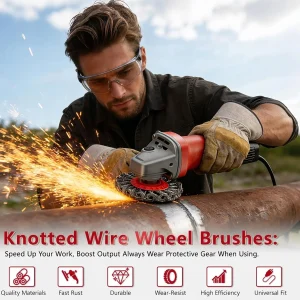
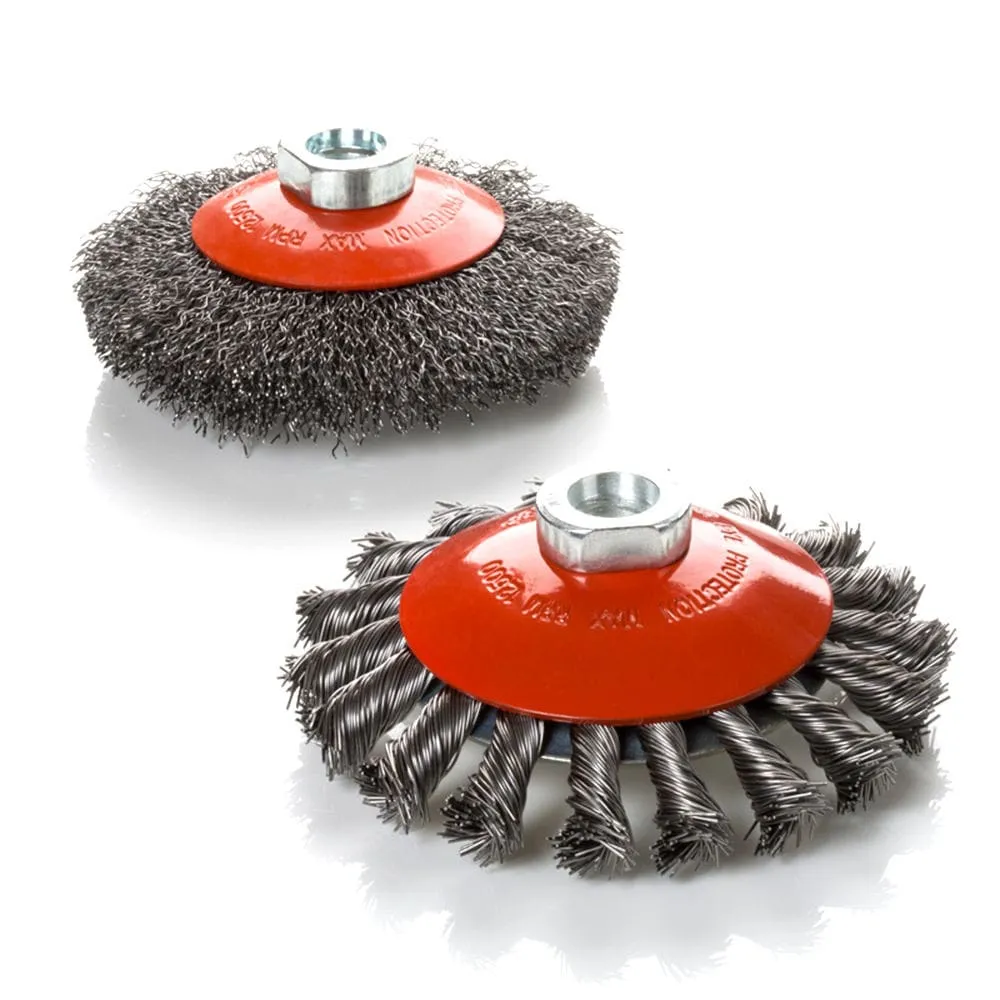
Carbon steel bristle hardness is 40–50 HRC (HRC: a metric used to measure a metal material’s resistance to indentation by a hard object — the higher the value, the harder the material), while stainless steel bristle hardness is 30–40 HRC — a full tier of difference in hardness, and the gap in actual grinding experience is very tangible. On the same carbon steel plate covered with thick rust, a carbon steel knotted wheel brush can reveal metallic luster in about 5 minutes; a stainless steel wheel brush may take 10 to 15 minutes.
However, this gap is not absolute — stainless steel bristles are tougher, which becomes an advantage in fine surface treatment.
When treating aluminum alloy sheets or stainless steel pipe fittings, the excessive rigidity of carbon steel brushes can easily leave overly deep scratches that compromise subsequent surface quality. Stainless steel brushes are gentler on the substrate, reducing unnecessary damage while still achieving the desired removal effect.
4.3 Full Lifecycle Cost: Do Not Look Only at Unit Price
This is the most neglected — and most consequential — dimension in procurement decisions. Let us walk through a calculation based on actual data:
- One carbon steel wire brush, unit price $3, scrapped after 1 week in a humid workshop → approximately 50 brushes needed per year → total cost $150
- One stainless steel wire brush, unit price $10, lasts 6 months in the same environment → 2 brushes needed per year → total cost $20
The math is clear at a glance — carbon steel brushes actually end up being more expensive in humid environments. The key lies in your actual operating conditions. If your warehouse is dry, the workpieces are carbon steel, and brushes are stored properly away from rain, then the annual consumption cost of carbon steel brushes may indeed be lower.
So whether something is “cheap or expensive” depends on how you use it, not on the price printed on the label. We recommend not just looking at the unit price on the supplier’s quotation. Take a few brushes of different materials and specifications to the shop floor for a one-week trial, and let the operators give you feedback — you will find that the most “cost-saving” solution is often not the one with the lowest quoted price.
The actual annual cost of stainless steel brushes is less than one-third that of carbon steel brushes. This is not complicated math, yet many procurement personnel have never seriously run the numbers. Cheap or expensive depends on your operating conditions, not on the price tag. If your workshop is dry and carbon steel brush lifespan is normal, this conclusion may reverse; but if conditions are humid, carbon steel brushes have no cost advantage whatsoever — they simply look cheap at the time of purchase. The recommended approach is to take a few brushes of different materials, trial them at the actual workstations for one to two weeks, plug lifespan and unit price into the calculation together, and then make your procurement decision.
4.4 High-Temperature Resistance
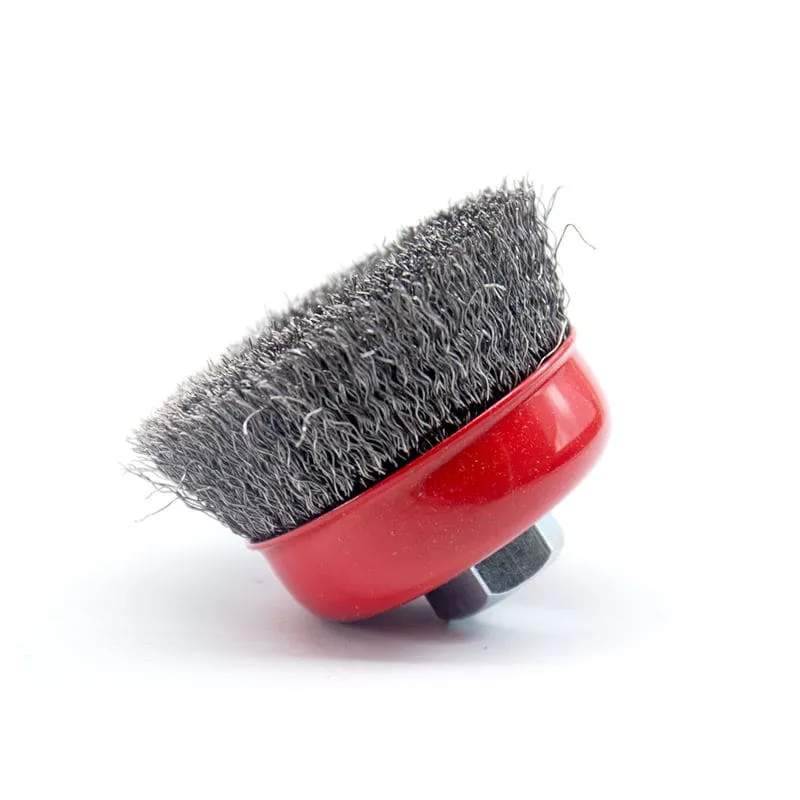
Carbon steel wire brushes begin to lose hardness and elasticity when exposed to temperatures above approximately 300–400°C, leading to rapid performance degradation in high-temperature applications.
Stainless steels such as 304 and 316 offer significantly better oxidation resistance at elevated temperatures, making them more suitable for cleaning hot workpieces.
In applications such as weld seam cleaning, furnace maintenance, and post-casting surface preparation, stainless steel wire brushes are generally preferred due to their superior heat resistance and reduced risk of contamination, while carbon steel brushes tend to wear out quickly under these conditions.
4.5 Industry Compliance Requirements
Different industries have explicit regulatory or certification requirements for brush materials, which must be cross-referenced during selection:
| Industry | Applicable Standards | Brush Requirement |
|---|---|---|
| Food Processing | FDA 21 CFR 177 / EU 1935/2004 | Stainless steel (Type 316 recommended) |
| Pharmaceutical Manufacturing | cGMP (21 CFR Part 211) | Stainless steel, traceability records required |
| Marine & Offshore Engineering | ISO 8501-1 | Stainless steel preferred |
| Stainless Steel Structural Welding | AWS D1.6 / EN 1090 | Stainless steel dedicated; separate management from carbon steel brushes |
| Nuclear Industry Equipment | ASME Section III | Stainless steel, controlled tool management |
| General Carbon Steel Processing | No special restrictions | Carbon steel is sufficient |
4.6 Common Misconceptions and Pitfall Avoidance Guide
- Misconception 1: “Stainless steel brushes never rust.” Type 304 stainless steel will undergo pitting corrosion in environments containing chloride ions (seawater, hydrochloric acid, bleach, chlorine-based cleaning solutions). If your workshop uses chlorine-based cleaners, stainless steel brushes still need to be rinsed clean and thoroughly dried after use. There is no absolutely rust-free steel in the world — only relatively corrosion-resistant steel. Exceed the material’s tolerance limits, and it will corrode.
- Misconception 2: “Carbon steel brushes are cheap — just throw them away when they wear out.” This logic holds in dry environments, but if carbon steel brushes are stored in a humid warehouse, they may begin to rust before they are even unpacked. The storage requirements for carbon steel brushes are far stricter than those for stainless steel — they must be kept dry, ventilated, and preferably in sealed packaging. Storing them casually with a “they’re cheap anyway” mentality will result in actual wastage rates far exceeding expectations.
- Misconception 3: “They are all for brushing metal, so any brush will do.” If you manufacture export products or fulfill orders with quality inspection requirements, brush material selection is a compliance issue — not a cost issue. Food equipment exported to the EU found to have iron contamination faces the prospect of entire shipment return or recall. That loss and saving a few dollars on brushes are simply not on the same scale.
- Misconception 4: “Buying the expensive one means no problems.” Stainless steel brushes are indeed more expensive, but if your workpieces are ordinary carbon steel, your workshop is dry, and your consumption volume is high, buying stainless steel brushes is purely a waste of money. Carbon steel brushes offer higher efficiency and lower cost in such operating conditions, and there is absolutely no iron contamination issue (the workpiece itself is carbon steel). The right one is the best one.
Daily Maintenance and Storage Guide for Wire Brushes
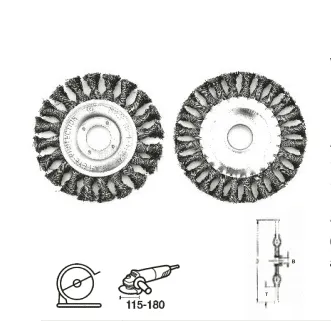
In a single sentence, the maintenance guide for wire brushes: Carbon steel brushes — protect against moisture (wipe dry after use, store away from water to prevent rust); stainless steel brushes — protect against cross-contamination (color-coded independent issuance and storage; strictly prohibit mixed brushing of dissimilar metals to prevent cross iron contamination).
Procurement Guide: Four Steps to Choosing the Right Wire Brush
The following is a selection process that has been repeatedly validated in actual business practice. You can evaluate your own operating conditions step by step against this framework:
Step 1: Look at the workpiece material
- Workpiece is stainless steel / aluminum alloy / copper alloy or other non-ferrous metals → Choose stainless steel wire brush (mandatory, non-negotiable)
- Workpiece is ordinary carbon steel / cast iron → Proceed to Step 2
Step 2: Look at the working environment
- Humid environment, outdoor operations, marine corrosion, or presence of chemical cleaning media → Choose stainless steel brush; otherwise, carbon steel brush lifespan will be very short, and the total cost of frequent replacement may not be economical
- Dry indoor environment, humidity-controlled, no corrosive media → Proceed to Step 3
Step 3: Look at removal requirements
- Need aggressive rust removal, heavy oxide scale removal, large welding slag cleanup → Carbon steel offers higher efficiency; prioritize carbon steel
- Fine surface treatment, need to preserve surface finish, removal of light oxidation discoloration → Stainless steel is more suitable
- Both requirements present → Consider a mixed configuration: carbon steel for rough grinding, stainless steel for finishing
Step 4: Calculate full lifecycle cost
- Estimate the actual service life of a single brush (based on operating conditions)
- Calculate “annual consumption × unit price = annualized cost”
- Factor in potential quality losses from workpiece contamination risk
- Make the final decision after comprehensive comparison
Ready to Find the Right Wire Brush?
How to find the right wire brush and choose a quality wire brush supplier?
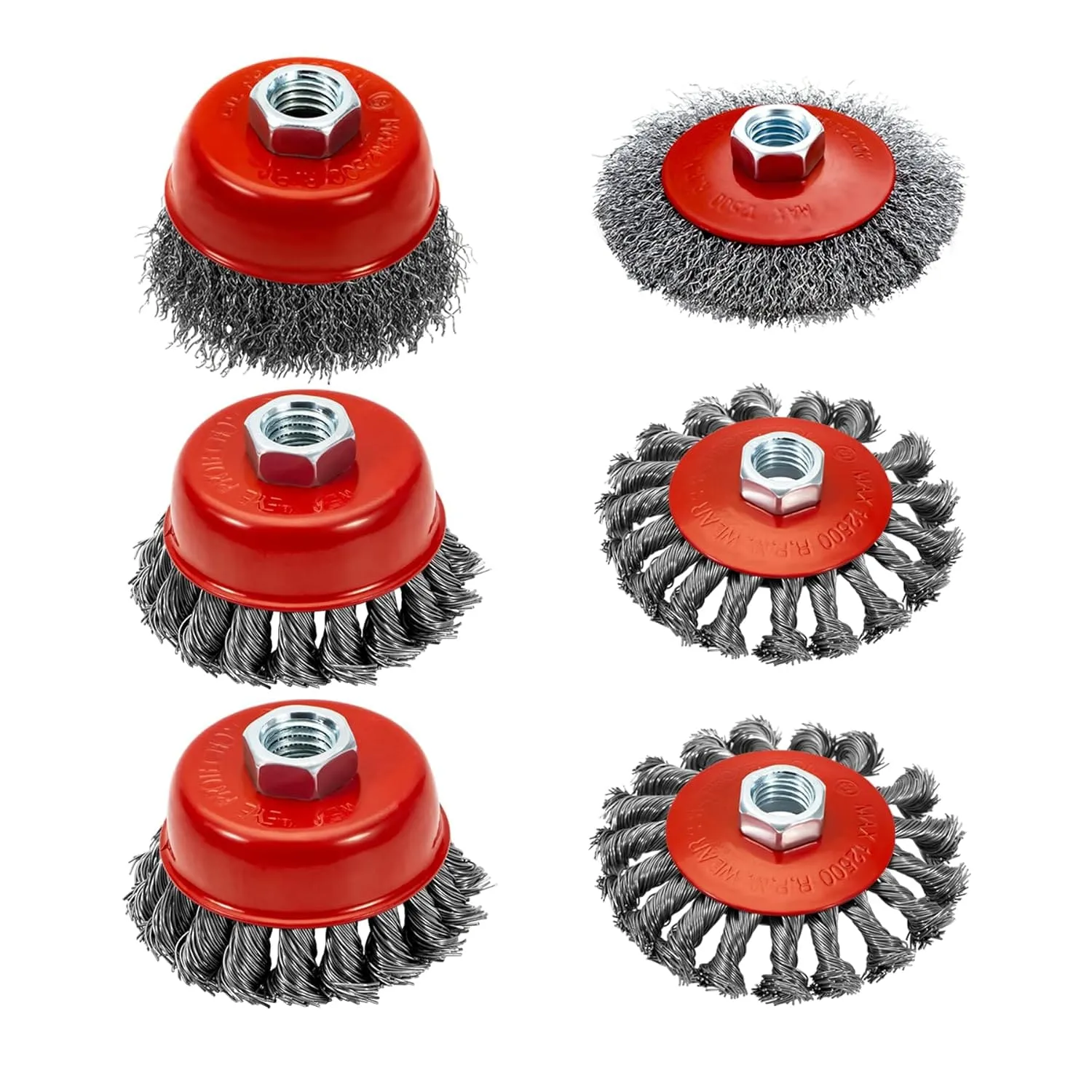
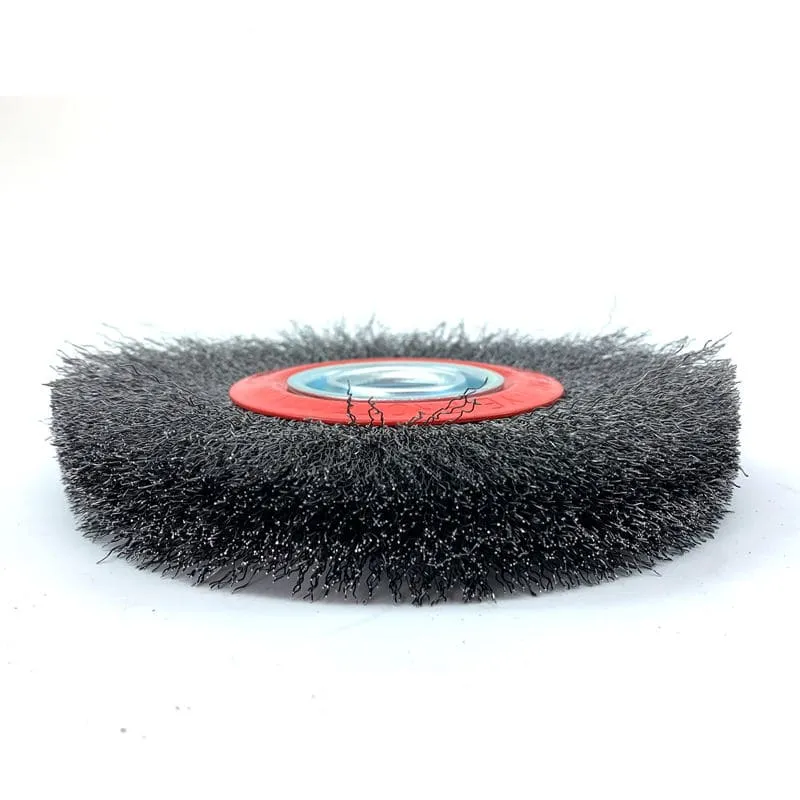
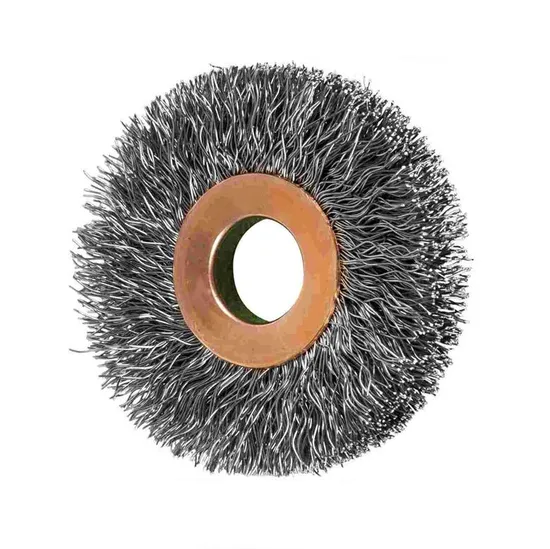
Our factory manufactures both carbon steel and stainless steel wire brush series, including wire cup brushes, wire wheel brushes, wire end brushes, wire pipe brushes, wire bevel brushes, hand wire brushes, and wire knife brushes. The stainless steel series uses Type 304 or Type 316 steel wire conforming to the ASTM A276 standard. Bristle diameter, number of wire strands per knot, arbor hole specifications, and maximum RPM can all be customized to your actual requirements. Export products are accompanied by Material Test Reports (MTR), meeting the traceability documentation requirements of high-demand industries such as food, pharmaceuticals, and marine.
If you are procuring wire brushes for your production line, distribution catalog, or project bidding, send us your workpiece material, operating environment, and annual consumption volume — our technical team will provide a selection recommendation and factory-direct quotation within 24 hours.
Conclusion
A wire brush may seem like an inconspicuous little item, but it plays a critical role in the entire surface treatment and coating process chain. Choosing the wrong brush can, at best, waste your procurement budget and, at worst, ruin a batch of products or even lose your customers’ trust.
To summarize the selection logic simply: Use a brush made of the same material as your workpiece — this is the baseline principle. On that foundation, weigh your decision comprehensively against the humidity and corrosiveness of the working environment, the required removal efficiency, and the full lifecycle cost. If you are a decision-maker responsible for bulk procurement, we recommend going beyond comparing unit prices and arranging a shop-floor trial — let the workers who actually use the brushes participate in the judgment. The experience in their hands is often more reliable than any quotation sheet.
FAQ
Q: Can carbon steel wire brushes be used on stainless steel workpieces?
A: No. Iron particles shed by carbon steel bristles during friction embed themselves into the stainless steel surface, destroying the chromium passive protective layer and triggering rust spots within 48 to 72 hours. The AWS D1.6 welding specification explicitly prohibits this practice, and it constitutes a non-compliant procedure in certified welding systems. Once iron contamination occurs, it can only be thoroughly removed through professional pickling and passivation — the rework cost far exceeds the expense of switching to the correct brush.
Q: Can stainless steel brushes be used on carbon steel workpieces?
A: Yes, absolutely no problem. Stainless steel brushes do not transfer harmful particles to carbon steel workpieces. The only trade-off is slightly lower cutting efficiency — removing heavy oxide scale will take a bit longer. If your workstation handles both types of material and separate management is inconvenient, switching entirely to stainless steel brushes is a viable solution. Costs will be somewhat higher, but there will be no workpiece contamination issues.
Q: Which type of brush must be used for food equipment maintenance?
A: Type 316 stainless steel wire brushes must be used — not Type 304, and definitely not carbon steel. Food processing involves extensive use of chlorine-based disinfectants. Type 304 is prone to pitting corrosion in environments with high chloride ion concentrations. Type 316, with its added molybdenum, offers stronger resistance to chloride ions and complies with FDA 21 CFR and EU 1935/2004 food contact material requirements. For products exported to European and North American markets, using the wrong brush material and being found with iron contamination can result in entire-shipment return or recall — a cost that a few brushes can never make up for.
Q: Can the same brush be used alternately on carbon steel and stainless steel workpieces?
A: Absolutely not. Once a stainless steel brush has made contact with a carbon steel surface, residual iron contamination on the bristles will still cause iron contamination when the brush is later used on stainless steel workpieces — the effect is no different in essence from using a carbon steel brush directly. The correct approach is color-coded isolation: red-handle brushes exclusively for carbon steel, blue-handle brushes exclusively for stainless steel, stored and issued physically separately. The implementation cost of this system is extremely low, yet it can prevent many unnecessary quality incidents.
Q: How should carbon steel brushes be stored to prevent rust?
A: Immediately after use, wipe off moisture and metal powder with a dry cloth, and store in a dry, ventilated area. A thin coat of anti-rust oil may be applied to the bristle surface. However, we need to be candid about one point: if the warehouse or workshop is chronically humid, these measures can only delay rusting — they cannot solve the fundamental problem. In humid operating conditions, you should be considering stainless steel brushes from the outset, rather than buying carbon steel brushes and relying on maintenance to extend their life.
Q: How to quickly assess the quality of stainless steel brushes during bulk procurement?
A: Three on-site quick inspection methods that require no specialized equipment.
- Magnet test: Cold-worked Type 304 stainless steel may have weak magnetism, but if the magnetic attraction is very strong, it is most likely a low-cost substitute made of Type 201 or Type 410 material, whose corrosion resistance is far inferior to Type 304.
- Wire diameter uniformity check: Randomly sample 10 bristles and measure their diameter with a micrometer. If the deviation exceeds ±0.02 mm, it indicates quality control problems, and the bristle breakage rate of such brushes will be noticeably higher.
- Weight comparison: If a brush of the same specification is noticeably lighter in weight, it indicates an insufficient number of bristles or material skimping, which will inevitably compromise service life.
Q: What is the minimum order quantity for wholesale procurement?
A: Our standard minimum order quantity is very flexible, with most products starting from 100 pieces. We understand the necessity of market testing and are happy to support small-batch initial orders to build cooperative relationships. For those with special specification requirements or mixed-model procurement needs, please contact our sales team to confirm the plan based on the actual situation.